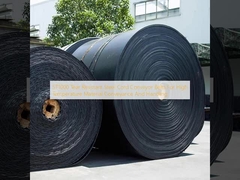
Brief: Our team walks you through how the Small Lumps Partition Cold Resistant Conveyor Belt performs in common building material handling scenarios. You'll see a detailed explanation of its baseband structure, learn how its unique partition design enables steep-angle conveying, and discover its operational benefits in ports, mining, and power plants.
Related Product Features:
Enables steep conveying angles from 30 to 90 degrees for efficient material transport.
Features specialized partitions that prevent material scatter during operation.
Constructed with cold-resistant cover rubber suitable for low-temperature environments.
Designed with horizontal rigid layers for enhanced structural stability and durability.
Ideal for transporting powdery, granular, small lumps, paste, and liquid materials.
Offers large conveying capacity with higher lifting heights in compact footprints.
Built with various core materials including cotton, nylon, polyester, and steel cord options.
Complies with GB7984-2001 standard ensuring quality and performance reliability.
Interrogazioni:
What types of materials can this conveyor belt handle?
This conveyor belt is specifically designed for transporting powdery, granular, small lumps, paste, and liquid materials that are prone to scattering, making it ideal for building materials and industrial applications.
What makes this conveyor belt suitable for cold environments?
The belt features cold-resistant cover rubber with a brittleness temperature of -40°C, ensuring flexibility and performance stability in low-temperature operating conditions.
What are the key advantages of the partition design?
The partition design significantly increases conveying angles up to 90 degrees, reduces material scatter, allows for higher lifting heights, and enables smooth transitions from horizontal to inclined conveying paths.
What industries typically use this conveyor belt?
It's widely used in ports, metallurgy, mining, electric power, coal, foundry, building materials, grain, chemical, and various other industrial fields for material transportation applications.